Expand description
§Architecture: wgpu, wgpu-core, and wgpu-hal
Here’s an overview of wgpu’s architecture.
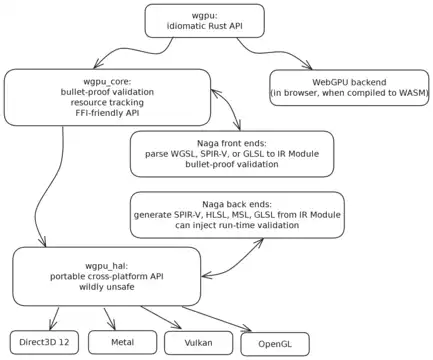
Working through this diagram from the bottom up:
-
Each operating system provides its own API (or APIs) for getting at the GPU:
-
On Windows, Direct3D is the primary GPU programming API, but Vulkan and OpenGL are often also available.
-
On macOS, Metal is the official GPU programming API, although OpenGL is still around for legacy programs, and the MoltenVK open-source project implements the Vulkan API on top of Metal.
-
On Linux, the Mesa library supports Vulkan and OpenGL.
If you want to write an application that runs on all three of these platforms, you have a few options:
-
You could target Vulkan, and for macOS support embed MoltenVK, or require your users to install it.
-
You could target OpenGL, which is no longer being developed and is missing many modern features, and worry that macOS will drop support for it altogether.
-
You could port it to all three native platform APIs: Direct3D, Vulkan, and Metal. This would be a lot of code.
-
Or, you could just use
wgpu!
-
-
The
wgpu_halcrate implements a portable Rust API that can use any of the platform-specific APIs mentioned above as a backend: a program that useswgpu_halcorrectly should behave consistently regardless of what platform you’re running on.However,
wgpu_hal’s interface is completely unsafe; you must follow all of its safety requirements to the letter to avoid provoking undefined behavior from the underlying platforms. These requirements are complex, and not well documented. Andwgpu_halperforms almost no validation beyond the minimum necessary to ensure portability. -
The
wgpu_corecrate builds onwgpu_halto provide an API with a similar flavor, preserving its portability, and adding full bullet-proof validation. By “bullet-proof”, we mean thatwgpu_coreis intended to be driven by untrusted code, like web content using the WebGPU API.wgpu_coreonly assumes that Rust’s safety rules are respected. Safe Rust code should not be able to cause a crash usingwgpu_core.This means that
wgpu_coreis fully responsible for things like tracking resource lifetimes, generating barriers for usage transitions, checking parameters, and so on. We cover its duties in more detail below.The
wgpu_corecrate’s API is designed to be easy to use from other languages via foreign function interfaces (FFI). This restricts the Rust features we can use in the API somewhat. But this makeswgpu_corethe best dependency for crates likewgpu_nativeand applications like Deno and Firefox that have their own binding systems. -
The
wgpucrate provides an idiomatic Rust API on top ofwgpu_core, inheriting its validation and portability. This is what most users in the Rust ecosystem will want.You can also compile
wgputo WebAssembly and run it in a web browser, having it drive the browser’s WebGPU implementation. In this mode of use,wgpu_coreandwgpu_halare not present. This can help you share code between in-browser and native versions of your app, by providing a single API for both versions to use.
§wgpu
The wgpu crate provides an idiomatic Rust API for cross-platform GPU-based
graphics and computation, modeled after the WebGPU JavaScript API.
The wgpu crate itself doesn’t contain much interesting graphics-related
code. It is mostly concerned with providing a consistent, idiomatic API that
applications can use to drive any one of several implementations:
-
The
wgpu::backend::wgpu_coremodule is available in native or Emscripten environments. It forwards all operations towgpu_core. MostBackendvalues, likeVulkanorMetal, go through this module. -
The
wgpu::backend::webgpumodule, available whenwgpuhas been compiled to WebAssembly, forwards calls to a browser’s WebGPU implementation. TheBackend::BrowserWebGpubackend selects this module. -
The
wgpu::backend::custommodule uses dynamic dispatch to let the user supply their own implementation. These are created via a separate mechanism, so they don’t use anyBackendvalue.
§wgpu_core
The wgpu_core crate implements a safe, cross-platform API on top of
wgpu_hal’s unsafe, cross-platform API. Almost every method in wgpu_hal’s
API is marked unsafe; it is wgpu_core’s job to satisfy or enforce every
requirement in wgpu_hal’s safety contracts. Then, wgpu_hal’s only
responsibility is to get consistent behavior across all its backends. This
relationship is explained more in
wgpu_hal’s documentation.
Beyond safety, wgpu_core also implements a few convenience APIs (for
example, mapped-at-creation buffers) on top of wgpu_hal’s more primitive
features.
§Lifetime tracking
The wgpu_hal API requires some objects to outlive others. For example, a
wgpu_hal::Device must outlive all resources (wgpu_hal::Buffer,
wgpu_hal::CommandEncoder, etc.) created from it. The wgpu_core types
ensure that these requirements are upheld, mostly just by using Arc.
TODO: Command-buffer resource usage through submission probably counts as “lifetime tracking” too.
This wgpu_hal requirement arises mostly from the Vulkan backend. Direct3D
and Metal both use reference counting internally for most operations, but
Vulkan foists the entire problem off on its users.
§Synchronization
Some types in the wgpu_hal API cannot be accessed simultaneously by
multiple threads. For example, most wgpu_hal::CommandEncoder methods take
&mut self. wgpu_core protects these hal types with Mutex as
appropriate.
There are a few other interesting requirements; for example, calls to
wgpu_hal::Queue::submit on a given Queue that could occur
simultaneously must use different Fences. wgpu_core addresses this by
simply wrapping wgpu_hal::Queue in a Mutex.
§Barrier generation
Vulkan and Direct3D require the user to include barriers in the command stream to notify the driver when a particular buffer or texture is transitioning from one kind of use to another. For example, if a texture is used as a render target and then sampled by a shader, Direct3D 12 requires a ResourceBarrier command between the two uses. Similarly, Vulkan requires VkCmdPipelineBarrier commands in some cases to ensure that values written to a resource by one operation will be seen by reads in a subsequent operation.
The wgpu_hal API passes these backends’ requirements through to its own
users, requiring calls to transition_buffers and transition_textures
between different kinds of access to such resources. But, following the lead
of WebGPU, the wgpu API does not require its users to record barriers.
This means that wgpu_core must track how each resource was last used, and
generate the barriers itself.
Since wgpu encourages users to record CommandBuffers in advance (ideally
in multiple threads), and then submit them in whatever order they please,
wgpu_core cannot know what states the resources that a CommandBuffer uses
will be in until it is actually submitted. Thus, each
wgpu_core::CommandBuffer merely records what states it expects the
resources it uses to be in initially, and which states it will leave those
resources in when it is done. Submission is then responsible for comparing
resources’ actual states with those expected by each
wgpu_core::CommandBuffer, and recording the necessary barriers in a fresh
wgpu_hal::CommandBuffer submitted ahead of it.
When recording a command buffer, since the commands are only being recorded
for later execution, and not executed immediately, a CommandEncoder tracks
the state each resource will be in when the given commands are executed,
and adds barriers to the recorded stream as appropriate. Naturally, the
CommandEncoder must treat each resource’s initial state as unknown, as it
has no way to know what other commands will be submitted ahead of it.
Note that, within a single wgpu_hal::Texture, individual array elements and
mip levels can be in different states. wgpu_hal::Buffers, however, have only
a single state.
Within wgpu_core, the Tracker type records a set of resources, their
current states, and (for command buffers being recorded) the initial state
they should be in. Tracker also notes which stateless resources (samplers;
render pipelines) a CommandBuffer uses, in order to keep them alive until
the commands have been submitted and finished running.
§MemoryInitTracker
Tracks the memory-initialization state of buffer resources, i.e. whether
they have been written to either by the user or by wgpu previously
zero-initializing them (WebGPU requires all buffers to behave as if they
are zero-initialized). A MemoryInitTracker tracks a single buffer and
allows inserting zero-initialization lazily on use. Zero-init is inserted if
necessary at:
- memory mapping, and
queue_submit(for all bindings).
§Device maintain
TODO (what/why).
§Cross-device use
The wgpu_hal API requires that a resource created with one
wgpu_hal::Device may not be used with a different Device. wgpu_core
tracks the Device to which each resource belongs, and checks for
cross-device use where necessary.
§General parameter validation
The wgpu_core crate is responsible for all the usual parameter validation
for graphics operations: a texture’s format must be supported by the device;
copies must not exceed the bounds of the buffers or textures involved; bind
groups need to have the right layout for the pipeline; and so on.
§API tracing
Enabled via a feature flag. Allows recording all usage (WebGPU API functions,
essentially) to a .ron file. Any additional data (data uploaded to a
buffer, etc.) is stored in additional files. A trace can be replayed with the
player compiled from the same wgpu revision. Used for testing and bug
reporting. See
Debugging wgpu Applications.
§Other WebGPU implementations
Note that wgpu represents only one possible way to implement the
WebGPU API; Google’s Dawn and
WebKit’s WebGPU module are other WebGPU implementations used in
production.
§The wider gfx-rs ecosystem
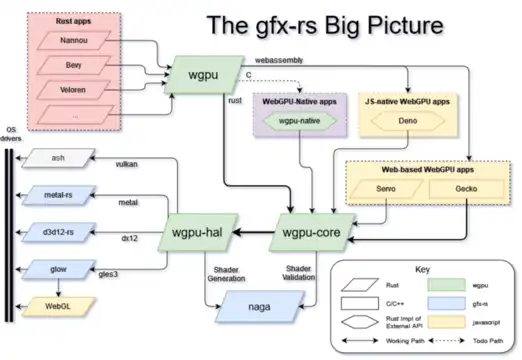
wgpu is one piece of the larger gfx-rs ecosystem. For a map of all the
components and how they fit together, see the big picture: